Quick Answer: Carrier management software helps brokers and shippers onboard carriers, verify FMCSA authority and insurance, store rates and contracts, tender loads and score carrier performance. Most teams use it inside a TMS so carrier data flows straight into dispatch and payments.
If you run a trucking company, you know the feeling. You have carriers you work with regularly. Some are great. Some are okay. Some keep you up at night wondering if they will actually show up. You have spreadsheets full of insurance certificates, rate agreements, and contact information. You need carrier management software to fix this.
In this short guide, I will explain what carrier management software does, why your trucking company needs it in 2026, and how to pick the right one. No fluff. Just practical help.
On this page
What Is Carrier Management Software?
Carrier management software (also called a Carrier Management System or CMS) helps you manage your relationships with freight carriers across the entire lifecycle. That means onboarding, contract management, performance monitoring, and dispute resolution.

According to FreightNav, a carrier management system focuses on optimizing carrier relationships, negotiating rates, ensuring compliance, and monitoring performance. The main goal is to improve efficiency and reliability.
The right question is not “Do we need carrier management software?” It is “Which carrier problems are we trying to stop repeating?”
Top Carrier Management Software Compared
Carrier management tools fall into two groups: full TMS platforms with carrier management built in, and specialist onboarding and fraud-check services that plug into a TMS. Many brokers use one of each.
| Tool | Type | Best for |
|---|---|---|
| McLeod Software | TMS for carriers and brokers | Established brokerages and asset carriers |
| MercuryGate | Enterprise TMS | Large shippers and 3PLs with complex networks |
| Manhattan TMS | Enterprise TMS | Shippers already using Manhattan supply chain tools |
| Highway | Carrier identity and fraud checks | Brokers fighting double brokering and identity theft |
| RMIS | Carrier onboarding and compliance | Monitoring insurance and authority at scale |
| MyCarrierPackets | Carrier onboarding packets | Fast digital onboarding for brokers |
| HorizonGO | All-in-one cloud TMS | Small and mid-size brokers and hybrid carrier-brokers that want onboarding, tendering and payments in one place |
Pick the specialist tools if fraud is your main risk and you move high volume. Pick an all-in-one TMS if you want carrier data, loads and payments in one system without stitching tools together.
The Market Is Growing Fast
The logistics software market was valued at USD 12.76 billion in 2025 and is projected to reach USD 23.89 billion by 2032, growing at 9.36% CAGR. The freight broker software market, which includes carrier relationship management software, is expected to grow from $2.22 billion in 2025 to $3.5 billion by 2032.
Drivers include automation demand, cloud adoption, and regulatory changes from the Federal Motor Carrier Safety Administration (FMCSA).
Problems Carrier Management Software Solves
Problem 1: Unpredictable carrier performance –
Late pickups, missed deliveries. Your customer doesn’t care which carrier caused it.
How CMS helps: Real-time performance scorecards. See which carriers deliver on time and which don’t.
Problem 2: Tribal knowledge and spreadsheets –
Insurance certs, rates, contracts live in inboxes or someone’s head.
How CMS helps: One central database for all carrier info. Good carrier management software gives you complete carrier profiles.
Problem 3: Compliance is getting harder –
FMCSA has new rules for CDLs, the MOTUS registration system, and the Drug & Alcohol Clearinghouse. Under 49 CFR 382.701, employers must query the Clearinghouse annually.
How CMS helps: Automated compliance tracking, insurance expiration alerts, document storage with audit trails.
Problem 4: You can’t answer simple questions –
Which carrier is drifting on on-time performance? Which exceptions are increasing?
How CMS helps:
Real-time dashboards and reports. Carrier management software turns data into action.
Key Features of Carrier Management Software
Carrier Onboarding and Compliance
| Feature | What It Does |
|---|---|
| Insurance tracking | Stores certs, sends renewal reminders |
| Documentation management | Centralizes contracts, W-9s, operating authority |
| Compliance dashboard | Shows which carriers are compliant |
| Automated onboarding | Qualifies carriers using custom rules |
If your compliance process is “ask Bob if we have the certificate,” you are one audit away from pain. Good carrier management software automates this.
Contract and Rate Management
| Feature | What It Does |
|---|---|
| Centralized rate storage | Stores rates by carrier, lane, equipment type |
| Expiration alerts | Warns when contracts are ending |
| Accessorial management | Tracks detention, layover, fuel surcharges |
Performance Scorecards
| Metric | What It Measures |
|---|---|
| On-time pickup | % of pickups within window |
| On-time delivery | % of deliveries on schedule |
| Tender acceptance rate | How often carrier accepts loads |
| Claims ratio | Damage claims as % of revenue |
According to McLeod Software, carrier management software lets you tailor scoring periods and weighting to reflect your risk tolerance and cost goals.
Tracking and Exception Workflows
| Feature | What It Does |
|---|---|
| Milestone events | Tracks pickup, in-transit, delivery |
| Proactive alerts | Notifies you of delays |
| Exception categorization | Groups exceptions by type, carrier, region |
| Escalation rules | Moves unresolved issues up the chain |
CMS vs TMS: What’s the Difference?
| System | Primary Focus | Key Functions |
|---|---|---|
| Carrier Management System (CMS) | Manage carrier relationships | Onboarding, compliance, scorecards, exceptions |
| Transportation Management System (TMS) | Transportation planning | Route optimization, load planning, freight audit |
A traditional TMS handles planning. Carrier management software picks up where TMS leaves off – managing ongoing relationships and performance. Many organizations use both.
What Makes HorizonGo Different
HorizonGo delivers powerful carrier management software capabilities inside a cloud-based TMS.
| Capability | What It Does |
|---|---|
| Carrier database | Centralized info, contacts, contracts |
| Compliance tracking | Insurance, authority, expiration alerts |
| Rate management | Store rates by lane and equipment |
| Performance monitoring | Track on-time pickup, delivery, claims |
| Document management | Attach certs, W-9s to carrier records |
| Settlement automation | Pay carriers accurately based on agreed rates |
Our carrier management software gives you connectivity, mobility, and visibility. Monitor shipments in real-time, optimize routes, and ensure on-time deliveries.
What Trucking Companies Are Saying
A fleet owner in Texas: “Before carrier management software, I had carrier info in spreadsheets, emails, and my head. Now everything is in one place. I know exactly which carriers perform and which cost me money.”
A dispatcher in Ohio: “The carrier management software saved me hours. I used to spend Monday mornings checking insurance certs. Now the system alerts me. I spend my time on actual dispatching.”
How to Choose Carrier Management Software
Step 1: Define requirements –
Prioritize what you need (compliance, rates, scorecards).
Step 2: Understand total cost –
Ask about implementation fees, per-carrier charges, subscription, support.
Step 3: Check references –
Ask similar companies about implementation time, support quality, and whether they would choose the same platform again.
Your Carrier Management Software Checklist
| Task | Status |
|---|---|
| List all carriers you work with | [ ] |
| Identify your biggest carrier pain points | [ ] |
| Write down must-have features | [ ] |
| Get demos from 2-3 CMS providers | [ ] |
| Ask about compliance tracking and alerts | [ ] |
| Check references | [ ] |
| Understand total cost of ownership | [ ] |
External Resources
| Organization | Link |
|---|---|
| FMCSA Registration Portal | li-public.fmcsa.dot.gov |
| FMCSA Drug & Alcohol Clearinghouse | clearinghouse.fmcsa.dot.gov |
| Unified Carrier Registration | ucr.gov |
| American Trucking Associations | trucking.org |
| McLeod Software (carrier solutions) | mcleodsoftware.com |
| FMCSA Company Snapshot | safer.fmcsa.dot.gov |
| eCFR 49 CFR 382.701 | ecfr.gov |
Final Thoughts
Carrier management software is not a luxury. It is a necessity. FMCSA regulations are stricter. Driver shortages continue. Customer expectations rise. You cannot manage carrier relationships with spreadsheets and tribal knowledge.
The right carrier management software gives you control. It automates compliance tracking. It gives you performance scorecards. It centralizes contracts and documents. It helps you fix problems instead of just reacting.
The best time to start was yesterday. The next best time is today.
HorizonGo helps trucking companies manage carriers, automate settlements, and grow their business with powerful carrier management software built for the real world. Visit HorizonGo.com to learn more or request a demo.
Carrier Management Software Features Checklist
Use this checklist when you compare carrier management software. The best carrier management solutions cover every step from onboarding to payment, so nothing falls between tools.
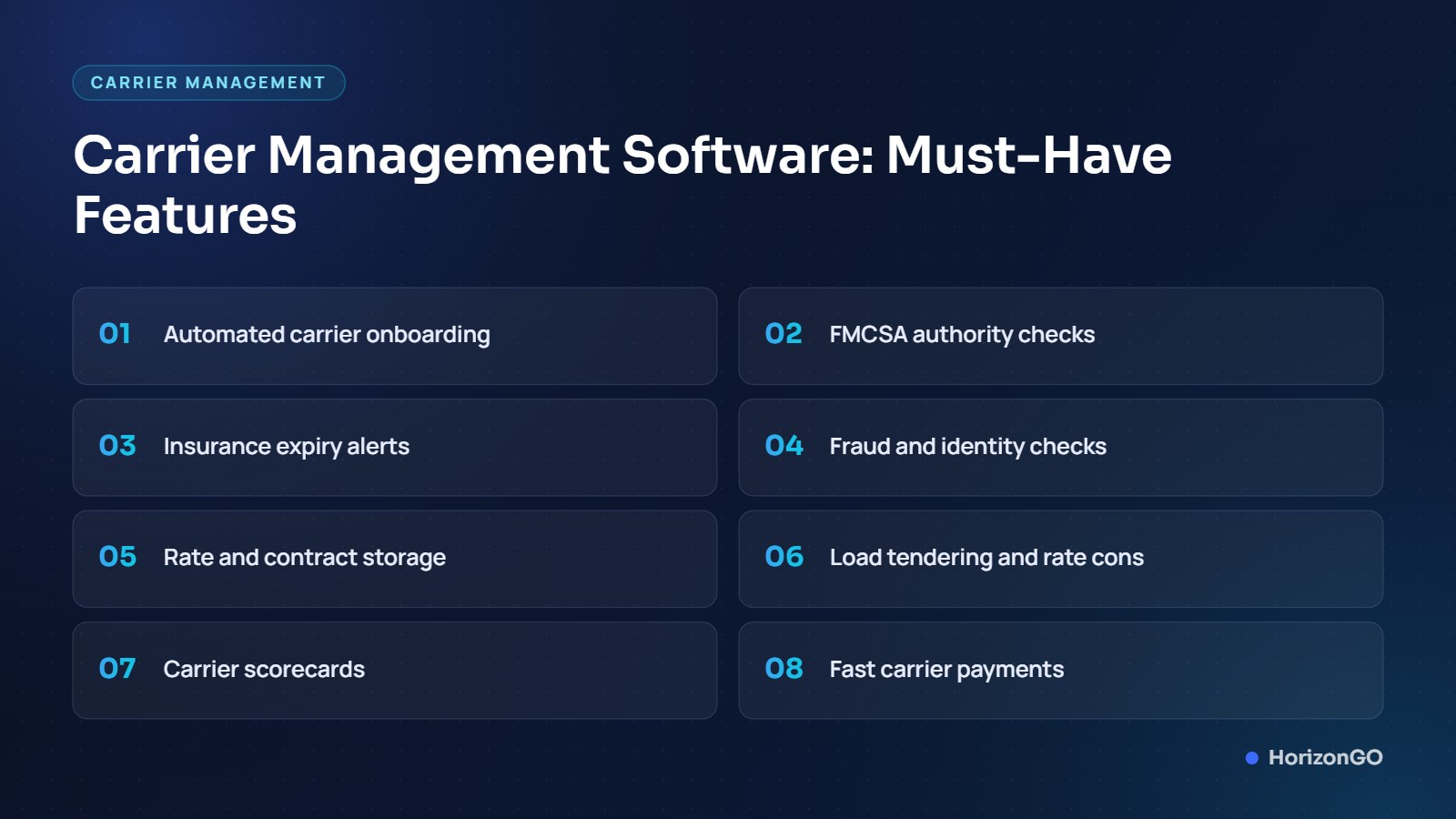
| Feature | Why it matters |
|---|---|
| Automated onboarding | Cuts carrier setup from days to minutes |
| FMCSA authority and safety checks | Avoids booking carriers that cannot legally haul |
| Insurance monitoring | Alerts you before coverage lapses |
| Fraud checks | Protects against double brokering and identity theft |
| Scorecards | Sends more freight to your best carriers |
| Integrated payments | Pays carriers accurately and keeps them loyal |
For the fundamentals, read our guide to the carrier management system, and compare full platforms in the best TMS software of 2026.
A Carrier Onboarding Workflow That Actually Works
Most brokers lose time on onboarding because every carrier gets handled a little differently. A simple, repeatable flow fixes that. Here is the order experienced carrier reps follow:
- Request the packet. Send one link that collects the W-9, certificate of insurance, operating authority and a signed broker-carrier agreement in one go.
- Verify authority. Check the MC number is active for the right type of operation and has been for a reasonable time. Brand-new authorities are not a problem in themselves, but they deserve a closer look.
- Verify insurance with the agent, not the PDF. Call or email the agent on the certificate to confirm the policy is live and the limits match what you need.
- Confirm identity and contact details. Match the phone number and email to the FMCSA record. A mismatch is the most common sign of an identity theft attempt.
- Set payment details once. Lock bank details after the first verified change and require a call-back before anyone can edit them.
When this flow lives inside your software, a new carrier can be approved in minutes instead of a day, and nothing depends on one person remembering the steps.
Red Flags That Point to Double Brokering or Fraud
Freight fraud has grown fast, and most of it starts at onboarding. Train your team to pause when they see any of these:
- The email domain is a free webmail address while the FMCSA record lists a company domain.
- The carrier asks to change bank details shortly after booking, often by email only.
- The MC number was recently reactivated or changed hands, and the fleet size on file does not match what the dispatcher describes.
- The rate is far below market and the carrier pushes to book immediately.
- Tracking is refused or the driver’s phone number keeps changing.
None of these proves fraud on its own, but two or more together are a good reason to call the carrier on the number listed with FMCSA before you tender the load.
Ongoing Monitoring After the Carrier Is Approved
Approval is not the end of the job. Insurance lapses, authority gets revoked and safety ratings change. Good monitoring checks your carrier list every day and flags anyone who falls out of compliance before they are offered another load. It should also keep a history, so you can show a shipper or an auditor exactly what you checked and when.
What to track for every carrier
- Authority status and any changes to it
- Insurance expiry dates and cancellation notices
- On-time pickup and delivery, and claims per 100 loads
- Tracking compliance and how often check calls are needed
- Payment disputes and how they were resolved
Payment Terms and Quick Pay
Carriers choose brokers partly on how fast they get paid. Standard terms are often 30 days, with a quick-pay option for a small fee. Whatever you offer, the key is consistency: pay on the date you promised, send a remittance that matches the invoice, and make it easy for carriers to check status without calling. A connected system that ties the rate confirmation, POD and invoice together removes most of the disputes that slow payments down.
Rolling It Out in Your Team
You do not need a big project. Most teams get good results with a 30-day plan:
- Week 1: write down your onboarding rules and decide who can approve exceptions.
- Week 2: move new carriers onto the digital packet and automatic authority and insurance checks.
- Week 3: import your existing carrier list and fix records with missing or expired documents.
- Week 4: start a simple weekly scorecard and share it with your top carriers.
Measure two numbers before and after: how long onboarding takes, and how many loads had a document or payment problem. Those two figures will tell you quickly whether the new setup is working.
Questions to Ask in a Software Demo
Sales demos tend to show the best-looking screens. Bring your own questions so you see how the tool handles a normal Tuesday, not a perfect one:
- How long does it take to onboard a carrier from first link to approved, start to finish?
- What happens when a carrier’s insurance expires in the middle of a load?
- Can you show me the audit trail for one carrier: who checked what, and when?
- How are bank detail changes verified, and who can approve them?
- Which load boards, ELDs and accounting tools does it connect to today, not on the roadmap?
- What does pricing look like when we double our carrier count?
- Who do we call when something breaks on a Friday night?
Ask the vendor to run one of your real lanes during the demo, with a carrier you already use. You will learn more in ten minutes of that than in an hour of slides. Also ask to speak to a current customer of a similar size; a vendor that serves large enterprise shippers may not be the best fit for a ten-person brokerage, and the reverse is true as well.
Finally, check how easy it is to leave. Make sure you can export your carrier records, documents and load history in a standard format. Good vendors are happy to show you this, because they expect to keep you on merit.
Carrier Management Software FAQs
What are carrier management solutions?
Carrier management solutions are software platforms or TMS modules that centralize carrier compliance, rates, capacity and performance in one place.
Is carrier management software part of a TMS?
Often, yes. Many TMS platforms, including HorizonGO, include carrier management so carrier data flows directly into dispatch and billing.
How does carrier management software prevent fraud?
It checks USDOT and MC authority against FMCSA data, monitors insurance and flags suspicious changes to contact or payment details.