

What People Are Searching For
Every day, thousands of small business owners, e-commerce sellers, and logistics professionals search for answers about LTL shipping. Here’s what they’re typing into Google:
| Keyword | Monthly Searches |
|---|---|
| LTL Shipping | 5,400 |
| LTL vs FTL | 3,600 |
| Freight Shipping | 22,000 |
| Trucking Companies Near Me | 90,000 |
| Freight Quote Calculator | 2,400 |
| LTL Freight Classes | 1,300 |
| How to Ship Freight | 2,400 |
| Pallet Shipping Cost | 1,900 |
| Freight Carriers | 1,900 |
| LTL Carriers Near Me | 1,300 |
| Shipping Large Items | 2,400 |
| Freight Delivery Services | 880 |
| LTL Rates | 1,600 |
| Freight Class Calculator | 1,900 |
| LTL Tracking | 1,600 |
Source: Google Keyword Planner, 2026
Behind every one of these searches is someone trying to figure out the same thing: “How do I ship this without spending a fortune?”
Maybe you’re a furniture maker with a dining table that’s too big for UPS. Maybe you’re an online seller who just got a wholesale order that fills four pallets. Maybe you’re a manufacturer shipping parts to customers across the country.
Whatever brought you here, you need straight answers about LTL shipping, what it is, how it works, what it costs in 2026, and how to avoid getting hit with surprise fees. This guide gives you those answers.
What is LTL Freight Shipping? (The Simple Version)
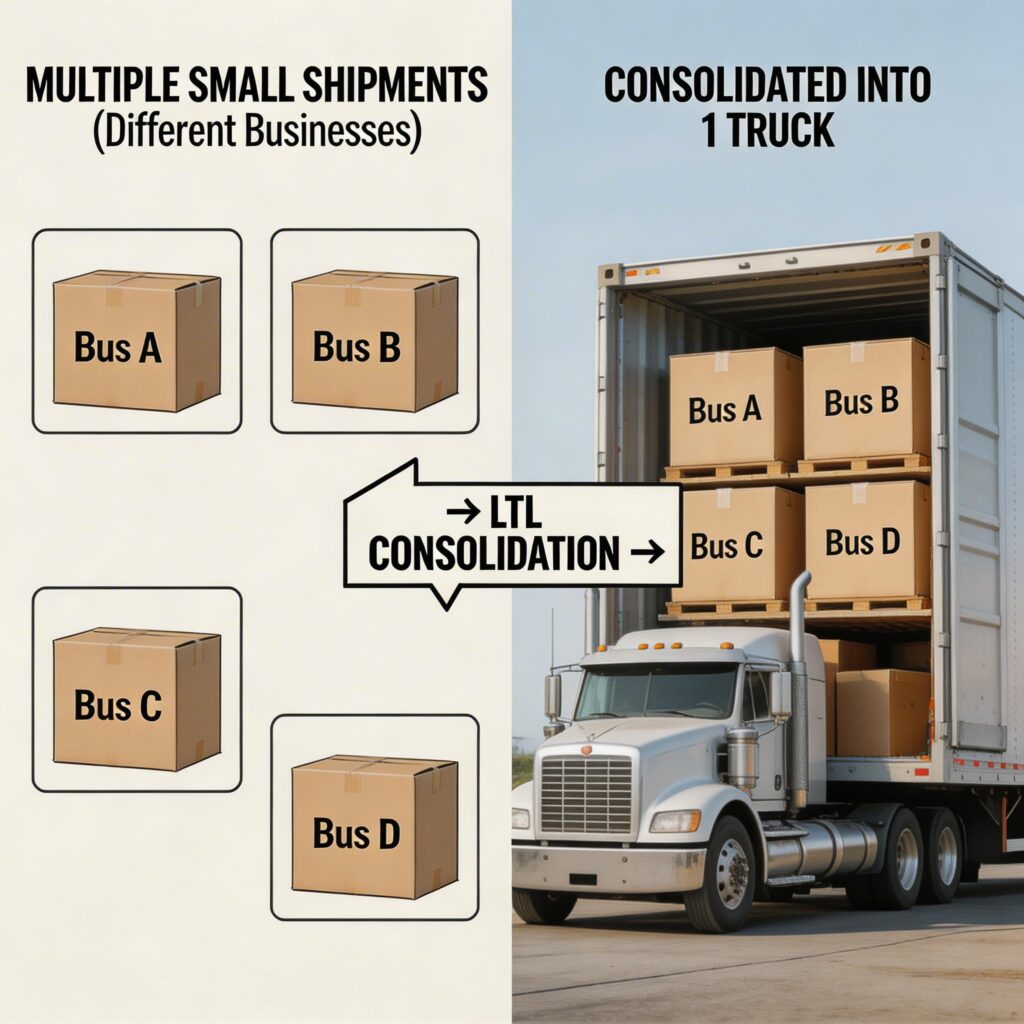
Less-Than-Truckload (LTL) is a shipping method for freight that’s too big for parcel carriers like UPS or FedEx but not big enough to fill an entire semi-trailer. LTL shipments typically weigh between 150 and 15,000 pounds.
Think of LTL like a rideshare for cargo. Your freight shares truck space with other companies’ shipments going in the same direction. Everyone splits the cost, so you pay only for the space you use . Carriers collect freight from various customers and route it through a network of terminals. At these hubs, shipments are sorted and loaded onto new trucks heading toward their final destinations .
When Should You Use LTL?
| Shipment Characteristic | LTL is Right When… |
|---|---|
| Weight | 150 – 15,000 pounds |
| Pallet Count | 1 – 10 pallets |
| Item Size | Too large for parcel carriers (UPS/FedEx) |
| Budget | You want to pay only for the space you use |
| Timing | Standard delivery (3-7 days) works for you |
Quick Comparison: LTL vs Other Shipping Methods
| Method | Typical Weight | Best For |
|---|---|---|
| Parcel (UPS/FedEx) | Under 150 lbs | Small packages, individual items |
| LTL | 150 – 15,000 lbs | 1-10 pallets, mid-sized shipments |
| FTL (Full Truckload) | 15,000+ lbs | 10+ pallets, full trailer loads |
If your shipment falls into that middle range, too heavy for parcel, not enough for a full truck LTL is your most cost-effective option.
The Big Change: New LTL Classification Rules for 2026
Here’s something you absolutely need to know. The LTL industry went through its biggest change in decades starting July 2025, and these rules are now fully in effect for 2026 .
What Changed?
The National Motor Freight Traffic Association (NMFTA) updated the classification system to be density-based for most commodities. About 30% of all freight classifications changed .
| Old System | New System (2026) |
|---|---|
| 18 freight classes (50-500) | Same 18 classes, but density-driven |
| Multiple classification factors | Density is primary factor for most items |
| Legacy lookup tools | ClassIT+ unified platform |
| Subjective handling assessments | Standardized density scales |
Why this matters to you: Under the new system, your freight class—and therefore your shipping cost—is determined primarily by how dense your shipment is. Light but bulky items now cost more to ship. Dense, compact items cost less .
FedEx Freight initially delayed enforcement of these changes until December 1, 2025, but they are now fully in effect for 2026 .
How to Calculate Your Freight Class (The Easy Way)
Your freight class determines your shipping rate. Lower class numbers (like 50) mean lower costs. Higher class numbers (like 500) mean higher costs .
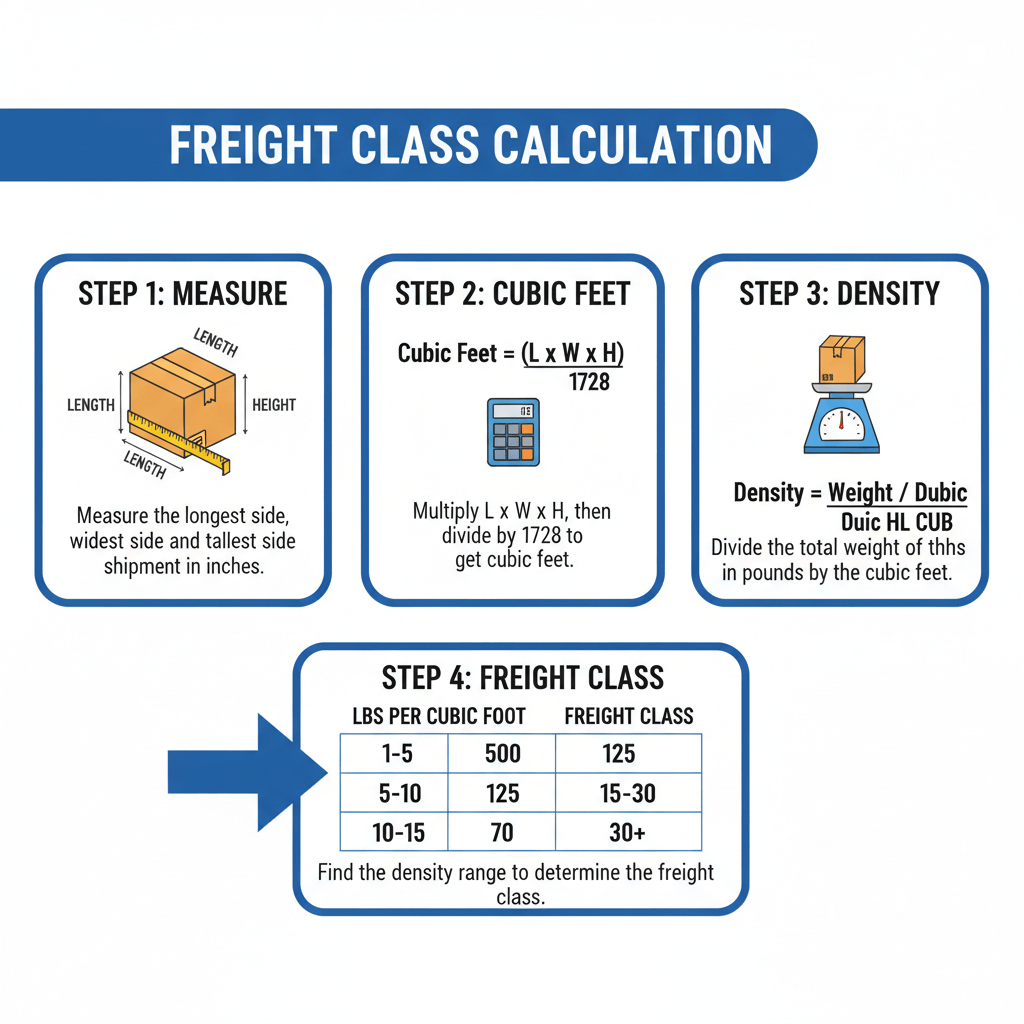
Step 1: Measure Your Freight
You need:
- Length (inches)
- Width (inches)
- Height (inches)
- Total weight (pounds, including pallet)
Step 2: Calculate Cubic Feet
Formula: (Length × Width × Height) ÷ 1,728 = Cubic feet
Example: A pallet measuring 48″ × 40″ × 48″(48 × 40 × 48) = 92,160 cubic inches92,160 ÷ 1,728 = 53.3 cubic feet
Step 3: Calculate Density
Formula: Weight ÷ Cubic feet = Density (pounds per cubic foot)
Example: That same pallet weighs 500 pounds500 ÷ 53.3 = 9.4 pounds per cubic foot
Step 4: Find Your Freight Class
Once you have your density, use this table to find your class :
| Class | Density Range (lbs per cubic foot) | Examples |
|---|---|---|
| 50 | 50+ | Bricks, steel, dense items |
| 55 | 35 – 50 | Heavy machinery parts |
| 60 | 30 – 35 | Auto parts, packaged goods |
| 65 | 22.5 – 30 | Carpet, mattresses (compressed) |
| 70 | 15 – 22.5 | Boxed goods, furniture |
| 85 | 12 – 15 | Electronics, appliances |
| 92.5 | 10.5 – 12 | Computers, monitors |
| 100 | 9 – 10.5 | Small appliances, packaged items |
| 110 | 8 – 9 | Books, printed material |
| 125 | 7 – 8 | Small household goods |
| 150 | 6 – 7 | Furniture, auto bumpers |
| 175 | 5 – 6 | Unboxed furniture |
| 200 | 4 – 5 | Mattresses, box springs |
| 250 | 3 – 4 | Car parts, tires |
| 300 | 2 – 3 | Empty boxes, packaging |
| 400 | 1 – 2 | Ping pong balls, empty containers |
| 500 | Less than 1 | Life rafts, loose items |
Critical tip: Always include the pallet in your weight and measurements. If you don’t, the carrier will re-weigh your shipment and adjust the class and your bill, after delivery.
Another important rule: If you ship items with different classes on the same pallet, the entire pallet defaults to the highest class among those items .
How Much Does LTL Shipping Cost in 2026?
LTL rates vary widely based on your shipment’s specifics. Here’s what you can expect:
General Rate Ranges
| Shipment Type | Typical Cost Range |
|---|---|
| Short haul, 1 pallet | $150 – $300 |
| Regional, 2-3 pallets | $300 – $600 |
| Cross-country, 1 pallet | $500 – $1,000+ |
| Cross-country, 4-6 pallets | $1,000 – $2,500+ |
What’s Happening with Rates in 2026
The LTL market is going through an interesting phase right now. Here’s what the experts are saying:
Current market conditions: The LTL market remains uneven and selective, with pricing stable in dense classes (70-85), rising in higher classes above 125, and compressing in heavier lower classes. The LTL Producer Price Index hit 435.205 in May 2025, showing 5.4% year-over-year growth. Rates are now approximately 66.5% above January 2018 baseline levels.
Rate increases: Most major carriers implemented General Rate Increases (GRIs) in 2025 ranging from 4.9% to 7.9% :
- Old Dominion: 4.9%
- FedEx Freight: 5.9%
- ABF Freight: 5.9%
- Saia: 7.9%
2026 outlook: Mid-single-digit rate increases are anticipated for 2026, consistent with the nearly 5% year-over-year growth observed over the past three decades . However, Q1 2026 rates are expected to decline less steeply than previous years, starting from a higher baseline .
What Affects Your LTL Rate?
| Factor | Impact on Price |
|---|---|
| Freight Class | Lower class = lower cost |
| Weight | Heavier shipments often have lower cost per pound |
| Dimensions | Bulky items cost more due to space used |
| Distance | Longer hauls cost more |
| Pickup/Delivery Locations | Remote areas may have surcharges |
| Accessorial Services | Extra fees for special handling |
| Fuel Surcharges | Fluctuates with diesel prices |
| Time of Year | Peak seasons may have higher rates |
Accessorial Charges: The Hidden Fees You Need to Know
This is where many first-time shippers get surprised. Accessorial charges are additional fees for services beyond standard dock-to-dock delivery .
Common Accessorial Fees
| Service | Typical Cost | When It Applies |
|---|---|---|
| Liftgate | $75 – $150 | No loading dock at pickup or delivery |
| Residential Delivery | $50 – $150 | Delivery to home, not business |
| Inside Delivery | $50 – $200 | Driver moves freight inside building |
| Limited Access Location | $50 – $100 | Schools, construction sites, farms |
| Detention | $50 – $100/hour | Driver waits beyond free time (usually 2 hours) |
| Reclassification Fee | Varies | Incorrect class on BOL |
| Reweigh Fee | Varies | Incorrect weight on BOL |
Pro tip: Declare all special requirements upfront. If you need a liftgate or residential delivery, say so when you book. Otherwise, the carrier will add these fees later—often at higher rates .
Top LTL Carriers for 2026
The LTL industry reached $52.8 billion in market size during 2024, with the top 25 carriers controlling 91% of total market share. This consolidation accelerated following Yellow Trucking’s bankruptcy in August 2023, with remaining carriers absorbing that capacity.
National LTL Carriers
| Carrier | 2025 Revenue | Key Strengths | Best For |
|---|---|---|---|
| FedEx Freight | $9.1 billion | Largest network, 400+ service centers, 85,000 daily shipments | National coverage, expedited services |
| Old Dominion | $5.8 billion | 99% on-time delivery, 16-year customer satisfaction leader, $575M infrastructure investment | Premium service, reliability |
| Estes Express | $5.0 billion | 12.4% growth, 47 new terminals, aggressive expansion | Regional expertise, expanding network |
| XPO Logistics | $4.9 billion | AI routing, automated load planning, technology leadership | Technology, international shipping |
| Saia | $3.2 billion | 12.2% tonnage growth, 21 new terminals | Regional expansion, West Coast strength |
Regional LTL Carriers
Regional LTL carriers often provide superior service within their coverage areas through concentrated terminal networks and local market expertise :
- Southeastern Freight Lines – Southeast region, damage-free delivery emphasis
- Dayton Freight – Midwest region, personalized service
- A. Duie Pyle – Northeast region, next-day regional delivery
- Averitt Express – Southeast and national, temperature-controlled capabilities
[Image: USA map showing coverage areas of major LTL carriers with color-coded regions]
ALT Text: United States map showing LTL carrier coverage areas with national carriers in blue and regional specialists in different colors
LTL vs FTL: Which Should You Choose?
Here’s a complete comparison to help you decide :
| Factor | LTL | FTL |
|---|---|---|
| Shipment Size | 1-10 pallets | 10+ pallets or full trailer |
| Weight | 150 – 15,000 lbs | 15,000 – 45,000 lbs |
| Cost Structure | Pay for space used | Flat rate for whole truck |
| Per-Unit Cost | Higher per lb for small loads | Lower per lb when full |
| Transit Time | 3-7 days (with stops) | 2-5 days (direct) |
| Handling | Multiple touches at terminals | Loaded once, unloaded once |
| Damage Risk | Higher due to handling | Lower (minimal handling) |
| Tracking | Scan-based (hourly updates) | GPS-based (real-time) |
| Best For | Small to mid shipments, budget shipping | Large volumes, fragile goods, urgent delivery |
Decision Guide
Choose LTL if :
- You have 1-10 pallets
- Your shipment weighs under 15,000 lbs
- You want to pay only for space you use
- Standard delivery timing works for you
- You need access to liftgate or residential services
Choose FTL if :
- You have 10+ pallets or 15,000+ lbs
- Your freight is fragile or high-value
- You need it there fast with no delays
- You can fill most of a trailer
- You require precise scheduling
How to Ship LTL Freight: Step-by-Step Process
Here’s exactly how to ship LTL freight in 2026, step by step .
Step 1: Classify Your Freight Accurately
Use the ClassIT+ tool (the official NMFC classification platform) to determine your freight class . Measure everything precisely, length, width, height, and total weight including pallet. Remember that under the new density-based system, accurate measurements are critical for proper pricing.
Step 2: Get Quotes from Multiple Carriers
Don’t rely on a single quote. Rates vary significantly between carriers for the same shipment . Use freight brokers or comparison platforms to access multiple quotes. Consider both national carriers and regional specialists based on your shipping lanes.
Step 3: Prepare Your Bill of Lading (BOL)
The Bill of Lading is your contract with the carrier. It must include :
- Exact weight and dimensions
- Correct freight class (verified with ClassIT+)
- Complete pickup and delivery addresses
- Contact names and phone numbers
- Any special instructions (liftgate, inside delivery, etc.)
- Declared value for insurance
Step 4: Package Your Freight Properly
LTL freight gets handled multiple times. Proper packaging protects your goods :
- Use a pallet – Standard 48″ × 40″ pallets are preferred
- Secure your load – Stretch wrap with 50% minimum overlap
- Protect fragile items – Use appropriate cushioning
- Consider stackability – Can your freight be safely stacked?
Step 5: Schedule Pickup
Most carriers require 24-48 hours advance notice for standard service . Ensure someone is available during the pickup window to inspect and sign for the freight.
Step 6: Track Your Shipment
LTL transit times typically range from 3-7 days depending on distance . Most carriers offer tracking through their websites or mobile apps. LTL tracking is typically scan-based, so updates come at key transit points rather than continuously.
Step 7: Inspect at Delivery
Before signing the delivery receipt :
- Inspect for visible damage
- Note any damage on the receipt
- Take photos if possible
- Get your signed copy
[Image: Step-by-step flowchart showing LTL shipping process from classification to delivery]
ALT Text: LTL shipping process flowchart with 7 steps from freight classification through delivery inspection
2026 Market Trends Affecting LTL Shipping
Capacity and Carrier Supply
Current truckload tightness is supply-driven, not demand-driven. Spot rates and tender rejection rates remain elevated despite tender volumes running 6-7% below year-ago levels . Carrier exits are now visibly impacting service and pricing. Years of attrition, exhausted balance sheets, and the end of pandemic-era financial buffers are translating into tighter capacity and weaker route-guide compliance .
Technology Investments
Modern LTL carriers deploy sophisticated routing algorithms and automated load planning systems . XPO Logistics leads technology adoption with AI-powered routing that dynamically adjusts for traffic, weather, and capacity constraints . Real-time tracking systems provide shipment visibility through GPS-enabled trucks and automated scanning at terminals.
Sustainability Initiatives
LTL shipping promotes sustainability by consolidating multiple shipments into one truck, reducing fuel usage and carbon emissions . Many carriers now participate in the EPA SmartWay Transport Partnership for freight efficiency . Environmental regulations and customer sustainability requirements drive technology investments in fuel-efficient equipment and alternative energy sources.
How to Reduce Your LTL Shipping Costs
Here are proven strategies to lower your LTL freight bills :
1. Optimize Your Packaging
Denser shipments get lower freight classes. Compress items when possible, use appropriately sized boxes, and minimize empty space. Remember: under the new density-based system, every cubic foot matters .
2. Provide Accurate Measurements
Carriers can, and will, re-weigh and reclassify your shipment. If your measurements are off, you’ll get a surprise bill later. Measure precisely and always include the pallet .
3. Consolidate Shipments
If you have multiple smaller shipments going to the same region, consolidate them into one LTL shipment. You’ll pay less per pound.
4. Compare Multiple Carriers
Rates vary significantly between carriers for the same lane. Use a freight broker or comparison platform to get multiple quotes .
5. Declare Accessorial Upfront
If you need a liftgate, residential delivery, or inside delivery, say so when you book. Declaring these needs upfront avoids higher after-the-fact charges .
6. Ship During Off-Peak Times
Avoid holiday rushes when possible. Rates often spike during peak seasons.
7. Consider Regional Carriers
For shipments within a specific region, regional carriers often offer better rates and faster transit than national carriers.
Official Resources and High-Authority Links
Here are government and industry resources where you can verify information and check carrier credentials:
| Resource | What It Provides | Link |
|---|---|---|
| FMCSA (Federal Motor Carrier Safety Administration) | Regulations, safety rules, carrier registration | fmcsa.dot.gov |
| FMCSA Company Snapshot | Verify carrier credentials, insurance, safety rating | safer.fmcsa.dot.gov |
| NMFTA (National Motor Freight Traffic Association) | Official freight classification authority | nmfta.org |
| FedEx Freight Class Calculator | Free density and class estimation tool | fedex.com/en-us/shipping/freight/ltl/class-calculator.html |
| Old Dominion Freight Line | Premium LTL carrier, rate quotes | odfl.com |
| Estes Express Lines | Major LTL carrier, tracking | estes-express.com |
| XPO Logistics | Technology-focused LTL carrier | xpo.com |
| C.H. Robinson Freight Market Update | Monthly market intelligence and rate trends | chrobinson.com/en-us/resources/insights-and-advisories/ |
| DAT Freight & Analytics | Spot rates, load boards, market trends | dat.com |
| American Trucking Associations | Industry data and economic reports | trucking.org |
LTL Shipping Checklist
Use this checklist when preparing your first LTL shipment:
Before Booking
- [ ] Weigh shipment accurately (include pallet)
- [ ] Measure length, width, height precisely
- [ ] Calculate density and determine freight class
- [ ] Identify any special requirements (liftgate, residential, etc.)
- [ ] Get quotes from at least 3 carriers
When Booking
- [ ] Verify carrier credentials on FMCSA website
- [ ] Confirm all accessorial charges upfront
- [ ] Get everything in writing
- [ ] Note pickup and delivery windows
Before Pickup
- [ ] Prepare accurate Bill of Lading
- [ ] Secure freight properly on pallet
- [ ] Apply stretch wrap (minimum 50% overlap)
- [ ] Have freight ready for scheduled pickup
At Delivery
- [ ] Inspect for damage before signing
- [ ] Note any issues on delivery receipt
- [ ] Take photos if damage is present
- [ ] Get signed copy of delivery receipt
After Delivery
- [ ] Review final invoice against quote
- [ ] Pay promptly to maintain good relationship
- [ ] Provide feedback to carrier/broker
Glossary of LTL Terms
| Term | Definition |
|---|---|
| Accessorial Charge | Additional fee for services beyond standard dock-to-dock delivery |
| Bill of Lading (BOL) | The primary shipping document; serves as contract and receipt |
| Density | Weight per cubic foot; primary factor in freight classification |
| Freight Class | NMFC classification number (50-500) that affects pricing |
| LTL | Less-Than-Truckload – shipments sharing truck space |
| Liftgate | Hydraulic lift on truck for locations without loading docks |
| NMFC | National Motor Freight Classification – the classification system |
| Pallet | Wooden platform for stacking freight (standard 48″×40″) |
| Reclassification | Carrier adjustment of freight class after inspection |
| Residential Delivery | Delivery to non-commercial location (incurs fee) |
Series: Complete Guide to Truck Loads
This guide is Blog 3 in our 8-part series on freight and logistics.
Blog 1: [What Are Truck Loads? The 2026 Complete Guide to Freight Types and Logistics]
Blog 2: [What is Full Truckload (FTL)? The 2026 Complete Guide]
Blog 3 (You’re Here!): What is Less-Than-Truckload (LTL)?2026 Best Guide
Blog 4: [Dry Van Loads: The Backbone of American Freight] (Internal Link)
Blog 5: [Reefer & Temperature-Controlled Loads: The 2026 Cold Chain Guide] (Internal Link)
Blog 6: [Flatbed & Oversized Loads: Hauling Guide for Heavy Equipment] (Internal Link)
Blog 7: [Specialized Freight: Hazmat, Tanker, Hot Shot & White Glove Services] (Internal Link)
Blog 8: [How to Start a Freight Brokerage in 2026] (Internal Link)
Have questions about LTL shipping or which carrier is right for your business? ( click here) . And if you ship your first LTL load using this guide, come back and tell us how it went!


