

Every day, thousands of businesses and individuals search for information about Full Truckload shipping. Here’s what they’re typing into Google:
| Keyword | Monthly Searches |
|---|---|
| Trucking Companies Near Me | 90,000 |
| Freight Shipping | 22,000 |
| Full Truckload | 5,400 |
| FTL vs LTL | 3,600 |
| Dry Van | 8,100 |
| Flatbed Truck | 6,600 |
| Reefer Truck | 4,400 |
| Dedicated Trucking Services | 1,600 |
| Freight Quote Calculator | 2,400 |
| Heavy Haul Trucking | 1,300 |
| How to Ship Freight | 2,400 |
| Freight Carriers | 1,900 |
| Truck Load Board | 2,900 |
| Temperature Controlled Trucking | 1,600 |
| LTL Freight Classes | 1,300 |
Source: Google Keyword Planner, 2026
Behind every one of these searches is someone trying to move products from Point A to Point B—manufacturers, retailers, farmers, construction companies, and small business owners who need clear answers.
This guide gives you those answers.
What is Full Truckload (FTL)?
Full Truckload (FTL) is a shipping method where your freight is the only cargo on the truck. The entire trailer is dedicated to your shipment from pickup to delivery.
Think of it like renting an entire moving truck for yourself. You load it your way. You drive directly to your destination. You don’t stop to drop off other people’s furniture. That’s exactly how FTL works.
In technical terms, FTL typically applies when your shipment weighs more than 15,000 pounds or occupies more than 24 pallet spaces in a standard 53-foot trailer. But you don’t have to fill the trailer completely—if you have 20 pallets and space left over, you’re still paying for the whole truck. That’s how the industry works.
Why FTL Exists
Full Truckload shipping exists because many businesses need to move large volumes of products efficiently. Manufacturers ship raw materials to factories. Retailers receive pallets of inventory for their stores. Food distributors move perishable goods across the country. Construction companies need materials delivered directly to job sites.
For all of these situations, FTL is the most practical solution.
How Full Truckload Differs from LTL(FTL vs LTL)?
The confusion between FTL and LTL is common. Here’s the difference in plain English:
FTL (Full Truckload) means your shipment has the entire truck to itself. It goes directly from your loading dock to your customer’s receiving dock with no stops in between.
LTL (Less-Than-Truckload) means your freight shares space with other people’s shipments. It gets picked up, taken to a terminal, sorted, loaded onto another truck, driven to another terminal, sorted again, and finally delivered.
Here’s a practical example: A furniture maker in North Carolina ships 500 dining chairs to a hotel in California. That’s 26 pallets. They need those chairs to arrive together, undamaged, and on time. FTL is their only real option.
A craft brewery in Colorado needs to send 200 cases of beer to a distributor in Nebraska. That’s 4 pallets. Not enough for a full truck, but too much for UPS. LTL is the right choice.
Key Differences at a Glance
FTL Advantages:
- Faster transit times (2-5 days cross-country)
- Minimal handling (loaded once, unloaded once)
- Lower damage risk
- Direct route with no intermediate stops
- Trailer can be sealed at origin
LTL Advantages:
- Pay only for the space you use
- No minimum volume requirement
- More frequent pickups possible
- Ideal for shipments under 15,000 pounds
The right choice depends entirely on your volume, timeline, and cargo type.
FTL Equipment Types: Finding the Right Trailer
Not all FTL shipments use the same equipment. The type of trailer you need depends on what you’re shipping.
Dry Van
Dry vans are what most people picture when they think of a semi-truck, the big box on wheels. They’re enclosed, weatherproof, and secure, but not temperature controlled.
Best for: Standard palletized goods that don’t need refrigeration. Electronics, clothing, furniture, retail merchandise, auto parts, non-perishable food.
Typical cargo: A clothing retailer shipping seasonal inventory from a distribution center to stores. An electronics manufacturer sending finished products to warehouses.
Refrigerated (Reefer)
Reefers are temperature-controlled trailers with built-in cooling systems. They maintain specific temperatures from -20°F to 70°F throughout transit.
Best for: Perishable products that spoil, melt, wilt, or degrade without temperature control. Fresh produce, frozen food, meat, dairy, flowers, pharmaceuticals.
Typical cargo: A flower wholesaler shipping tulips from Miami to florists across the Midwest, kept at a steady 34°F. A pharmaceutical company delivering vaccines that must stay cold.
Flatbed
Flatbed trailers have no sides and no roof, just a flat platform. They’re for stuff that’s too tall, too wide, or too oddly shaped to fit in an enclosed trailer.
Best for: Construction materials, heavy machinery, infrastructure components. Lumber, steel beams, pipe, equipment, building materials.
Typical cargo: A steel distributor shipping beams to a construction site. An equipment dealer delivering an excavator to a contractor.
Specialty Trailers
Beyond the main types, several specialty trailers exist for specific cargo:
Step deck: Lower rear deck for taller cargo that exceeds standard flatbed height limits.
Lowboy: Extremely low deck with ramps. Heavy equipment drives onto it.
Removable gooseneck (RGN): The front detaches for drive-on loading. For extremely heavy loads like cranes and transformers.
Tanker: Cylindrical tanks for liquids and gases. Fuel, chemicals, milk, cooking oil.
Dump trailer: Hydraulic lift for loose bulk materials. Gravel, sand, dirt, demolition debris.
Where FTL is Used: Major US Freight Hubs
Full Truckload shipping moves through every city in America, but certain cities are major freight hubs with high volumes of FTL activity. If you’re looking for FTL services, these cities have the most carrier availability and competitive rates.
| Region | Key Freight Hubs |
|---|---|
| Northeast | New York City • Newark • Philadelphia |
| Southeast | Atlanta • Miami • Memphis • Savannah |
| Midwest | Chicago • Indianapolis • Columbus • Detroit |
| South Central | Dallas-Fort Worth • Houston • New Orleans |
| West Coast | Los Angeles/Long Beach • Oakland • Seattle |
| Mountain West | Denver • Phoenix • Salt Lake City |
FTL Pricing: What It Costs in 2026
FTL rates fluctuate based on multiple factors. Here are the current averages for early 2026:
Average rates per mile:
- Dry van: $1.60 – $1.80
- Reefer: $2.00 – $2.30
- Flatbed: $1.90 – $2.10
- Heavy haul: $2.50 – $3.50+
- Expedited: $3.00 – $5.00+
For a 1,000-mile shipment, expect to pay roughly $1,600 to $2,300 depending on equipment type.
What Affects Your Rate
Distance: Longer hauls cost more total but less per mile because fixed costs are spread out.
Lane: Popular routes like Atlanta to Dallas have more trucks and better rates. Remote locations cost more because trucks may have to deadhead (travel empty) to their next pickup.
Season: Holiday seasons spike demand. Harvest time increases reefer rates. Winter weather can disrupt capacity.
Fuel: Rates include fuel surcharges that adjust weekly based on diesel prices.
Equipment type: Specialized equipment like reefers and flatbeds costs more than standard dry vans.
Accessorials: Extra services add fees. Liftgate, detention (waiting time), lumper (unloading service), inside delivery, and residential delivery all cost extra.
Market conditions: When capacity is tight, rates go up. Early 2026 is seeing capacity tightening and upward rate pressure.
2026 Market Outlook
According to C.H. Robinson’s January 2026 Freight Market Update, FTL spot rates are projected to grow approximately 8% year-over-year, up from earlier forecasts of 6%. This is driven by:
- An exceptionally active winter in December 2025
- Tighter capacity than expected
- A shrinking pool of available carriers
The TD Cowen/AFS Freight Index shows FTL rates in Q2 2025 stood 5.9% above the January 2018 baseline, driven by inventory pull-forwards, natural disasters, and ongoing capacity adjustments.
Industries That Rely on FTL
Full Truckload shipping is essential across multiple industries:
Manufacturing: Raw materials move to factories; finished goods move to warehouses. Just-in-time inventory systems depend on reliable FTL delivery.
Automotive: Parts and components move between suppliers and assembly plants on strict schedules. Production lines stop if shipments are late.
Retail: Store inventory and seasonal merchandise move from distribution centers to retail locations. Large volumes require dedicated trucks.
Food and Beverage: Packaged goods, bottled products, and ingredients move from producers to distributors. Temperature-sensitive items need reefers.
Construction: Building materials and equipment need direct-to-site delivery. Oversized items require flatbeds and specialty trailers.
E-commerce: Bulk inventory moves to fulfillment centers. Large transfers between warehouses keep online orders flowing.
Pharmaceutical: Medicines, vaccines, and supplies require temperature control and security. Cold chain integrity is critical.
Agriculture: Grain, feed, produce, and livestock move from farms to processors and markets. Seasonal volume spikes require available capacity.
How to Book an FTL Shipment
Booking your first FTL shipment is straightforward when you follow these steps.
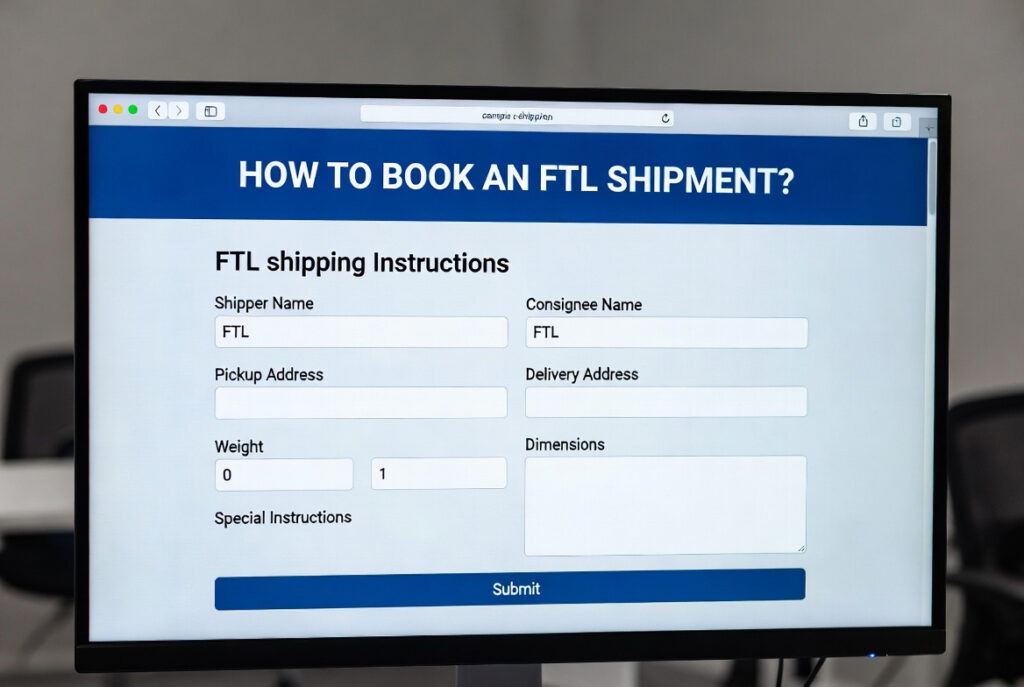
Step 1: Gather Your Shipment Details
You need accurate information:
- Exact weight (or close estimate)
- Dimensions of each piece or pallet
- Total pallet count
- Freight type (any special requirements)
- Pickup location with dock hours
- Delivery location with receiving hours
- Desired pickup and delivery dates
Step 2: Choose How to Book
Direct with carriers: Contact trucking companies directly. Works well for large volumes, regular lanes, and building relationships.
Freight broker: Brokers connect you with carriers from their network. Good for most shippers, especially first-timers.
Digital freight platform: Online platforms like DAT, Truckstop.com, or Uber Freight provide instant quotes and transparent pricing. Good for one-off shipments.
Step 3: Get and Compare Quotes
When you receive quotes, don’t just look at price. Consider:
- Transit time
- Equipment quality
- Carrier reputation
- Communication and tracking
- Experience with your freight type
Step 4: Book and Prepare
Once you choose a carrier:
- Get everything in writing
- Confirm pickup and delivery windows
- Exchange contact information
- Complete the Bill of Lading accurately
Step 5: Track and Confirm
Most carriers provide tracking. Use it. When delivery happens:
- Inspect for damage before unloading
- Count everything
- Note any issues on delivery receipt
- Get your signed copy
Official Resources for FTL Shipping
These government and industry resources provide authoritative information for verifying carriers and understanding regulations.
Government Resources
FMCSA (Federal Motor Carrier Safety Administration) – The primary government agency regulating trucking. Find safety rules, compliance requirements, and carrier registration information.
fmcsa.dot.gov
FMCSA Company Snapshot – Verify any carrier’s safety rating, insurance status, and operating authority. Free and essential before booking.
safer.fmcsa.dot.gov
FMCSA Licensing and Insurance – Check broker and carrier authority.
li-public.fmcsa.dot.gov
FHWA Size and Weight Program – Federal size and weight limits, bridge formula requirements.
ops.fhwa.dot.gov
PHMSA (Hazardous Materials) – Regulations for shipping hazardous materials.
phmsa.dot.gov
Industry Resources
American Trucking Associations – Industry data, economic reports, policy information.
trucking.org
DAT Freight and Analytics – Spot rates, load board, market trends.
dat.com
FreightWaves – News, market analysis, SONAR data.
freightwaves.com
Truckstop.com – Load board, freight matching, market data.
truckstop.com
Major Carriers
J.B. Hunt – One of the largest FTL carriers, industry insights.
jbhunt.com
XPO Logistics – FTL and LTL carrier, industry resources.
xpo.com
Old Dominion Freight Line – Industry leader in service quality.
odfl.com
Schneider – Major FTL carrier with diverse equipment.
schneider.com
Knight-Swift – Largest FTL carrier in North America.
knight-swift.com
FTL Market Statistics
The Full Truckload market is substantial and growing:
- North America road freight market (2025): ~$800 billion
- Projected market size (2033): Exceeding $2 trillion
- Projected CAGR (2025-2033): Exceeding 13.5%
- US FTL market (2025): $448.65 billion
- US FTL market (2031 projection): $547.89 billion
- Manufacturing share of FTL market: 31.55%
Sources: Market Signal Reports, Mordor Intelligence
Common FTL Mistakes to Avoid
Choosing FTL for small loads: If you’re shipping under 15,000 pounds, you’re likely paying for empty space. Consider LTL or partial truckload.
Poor loading practices: Uneven weight distribution causes accidents. Poorly secured loads damage goods. Load properly or hire professionals.
Booking too late: Limited carrier options, premium rates, and missed deadlines result from last-minute booking. Plan ahead.
Focusing only on price: The cheapest carrier often has poor service, old equipment, and low reliability. Consider the whole picture.
Ignoring accessorials: Unexpected fees blow budgets. Ask about all potential charges upfront.
Incomplete paperwork: Wrong addresses, weights, or descriptions cause delays. Double-check everything.
Not tracking shipments: You won’t know about delays until customers call. Use carrier tracking tools.
Assuming all carriers are the same: Service quality, equipment age, and reliability vary widely. Vet your carriers.
Series: Complete Guide to Truck Loads
This guide is Blog 2 in our 7-part series on freight and logistics.
Blog 1: [What Are Truck Loads? The 2026 Complete Guide to Freight Types and Logistics]
Blog 2 (You’re Here!): [What is Full Truckload (FTL)? The 2026 Complete Guide]
Blog 3: [Less-Than-Truckload (LTL): The 2026 Cost-Saving Guide for Small Businesses] (Internal Link)
Blog 4: [Dry Van Loads: The Backbone of American Freight] (Internal Link)
Blog 5: [Reefer & Temperature-Controlled Loads: The 2026 Cold Chain Guide] (Internal Link)
Blog 6: [Flatbed & Oversized Loads: Hauling Guide for Heavy Equipment] (Internal Link)
Blog 7: [Specialized Freight: Hazmat, Tanker, Hot Shot & White Glove Services] (Internal Link)
Have questions about Full Truckload shipping? (Click here)


